Wholesale Electricity Spot Market (WESM) proposed Visayas Supply Augmentation Auction (VSAA) Program which was approved by the Energy Regulatory Commission (ERC). The VSAA is aimed for demand-side management (DSM) in Visayas where interruptible load of embedded generators will be auctioned just like a competitive market. Please see approved proposed VSAA.
There have been reports that Visayan Electric Co. (Veco) has been practicing (DSM) by having interruptible contracts to its consumers. See this link: Veco, firms to sign power deal.
My question is this: Veco has a working DSM model system. Was there a study providing benefits of a market based DSM compared to the existing practice? Is there a need for a market based DSM that would add another fraction of peso to the rates being charged?
With ERC's approval, market based DSM will go through WESM instead of having Veco and its consumers taking directly. There might be added cost to that. You can say this is only Veco, how about the other distribution utilities? Well, the Veco model works as reported, why not adapt the model that works fine.
Why another route?
Saturday, April 25, 2009


Friday, April 24, 2009
Demand Side Management in Visayas: Making It Work
As Visayas is having power problems, demand side management brings new opportunities to alleviate need for investments in new generation.
Inquirer reports...Ten major commercial establishments in Cebu let go of at least 174,847 kilowatt hours (kwH) of power from the local power grid over the past two weeks, allowing more electricity to be used by residences.
The “deloading” from the power grid was made by firms which relied on their own backup generators during periods of peak demand for electricity in Cebu.
See link for full report: Firms start power deload
Inquirer reports...Ten major commercial establishments in Cebu let go of at least 174,847 kilowatt hours (kwH) of power from the local power grid over the past two weeks, allowing more electricity to be used by residences.
The “deloading” from the power grid was made by firms which relied on their own backup generators during periods of peak demand for electricity in Cebu.
See link for full report: Firms start power deload
Saturday, April 11, 2009
Now You're Talking
The Institute of Integrated Electrical Engineers of the Philippines Inc.(IIEE), a group for local electrical engineers warned electric grid operator National Grid Corporation of the Philippines against employing foreign nationals as engineers to run the country’s power distribution network.
Read full article at Inquirer website - Grid firm warned vs hiring foreign engineers.
This is one concrete benefit of having a professional organization looking out for the welfare of its members. To IIEE, mabuhay!
Read full article at Inquirer website - Grid firm warned vs hiring foreign engineers.
This is one concrete benefit of having a professional organization looking out for the welfare of its members. To IIEE, mabuhay!
Wednesday, April 8, 2009
Interruptible Load Application in the Philippines
Power drops 30 MW
Posted 01:43pm (Mla time) (Mla time)
By Cris Evert Lato
Cebu Daily News
A 30-megawatt (MW) power shortage last Tuesday forced a mall and hotel in Cebu City to rely on its own generator sets for one hour and reduce its demand on the Visayan Electric Co. (Veco). [ Read more ]
VECO Application to the Energy Regulatory Commission
Posted 01:43pm (Mla time) (Mla time)
By Cris Evert Lato
Cebu Daily News
A 30-megawatt (MW) power shortage last Tuesday forced a mall and hotel in Cebu City to rely on its own generator sets for one hour and reduce its demand on the Visayan Electric Co. (Veco). [ Read more ]
VECO Application to the Energy Regulatory Commission
Tuesday, March 31, 2009
Philippines' Earth Hour: Success or Failure
One way to evaluate if the Earth Hour in the Philippines is successful or not is to compare the megawatt (MW) demand on March 21, 2009 and March 28, 2009. The Earth Hour was on March 28 at the time of 8:30 pm to 9:30 pm. We choose March 21 since this day is another Saturday which is the same as March 28. Inquirer reports that RP shone in dim during that hour. Philippine Star wrote that RP had record power savings during the event.
The facts say otherwise. The graph below describes the demand in Luzon and Visayas regions for March 21 and 28, 2009. The data were taken from Wholesale Electricity Spot Market (WESM) website. Comparing the demand curve of March 21 and 28 during the Earth Hour, we observed that there was more power utilization on March 28 than March 21. I am not sure where Inquirer and Philippine Star got their data.
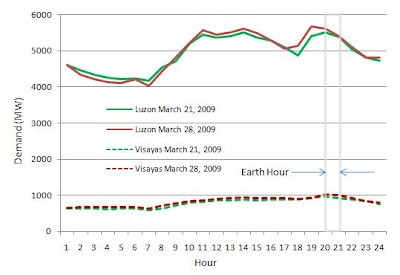
The facts say otherwise. The graph below describes the demand in Luzon and Visayas regions for March 21 and 28, 2009. The data were taken from Wholesale Electricity Spot Market (WESM) website. Comparing the demand curve of March 21 and 28 during the Earth Hour, we observed that there was more power utilization on March 28 than March 21. I am not sure where Inquirer and Philippine Star got their data.

Saturday, October 25, 2008
Reliability of Philippine Power Systems
Reliability of power systems define the utility's capability to minimize outage frequency and duration. For regulatory purposes, power system reliability indices are evaluated for performance based regulation (PBR). In the Philippines three performance indicators on system reliability are among the indices evaluated to assess transmission and distribution electric systems for regulatory years involved. System Average Interruption Frequency Index (SAIFI), System Average Interruption Duration Index (SAIDI) and Customer Average Interruption Duration Index (CAIDI) are the indices required by Energy Regulatory Commission (ERC) from the utilities and whose formulas are given below. The data presented herein are acquired from the ERC website and from the National Electrification Administration (NEA) website.

The transmission electric system reliability performance are provided below in the following two figures. The first five years show separated indices for the three regions while the next five years show combined transmission performance for the whole nation. It is revealed from the figures that transmission system SAIFI and SAIDI are lower for the last five years which indicate that outage frequency and duration were minimized in the bulk power system.


The next three figures illustrate the reliability performance of four Distribution Utilities (DUs) in Mindanao. The SAIDI presented here are said to be "Planned" SAIDI, which I assume incurred during scheduled maintenance outages of the DUs. For SAIFI and SAIDI, Cotabato Light and Power Company, Inc. (CLPC) performs better than the other DUs. For CAIDI, Mactan Electric Company, Incorporated (MECO) and Cagayan Electric Power and Light Co., Inc. (CEPALCO) provides minimum customer outage duration. What is interesting is that MECO and CEPALCO reported the same CAIDI values for different four year intervals. The CAIDI formula above does not apply to the CAIDI values as the SAIDI are "Planned". The DU reliability assessment here does not consider the GWh sales and number of customers served of the DU which I believe has an impact to the DU reliability performance. This kind of evaluation is slated in the upcoming articles.


NEA reports a reliability criteria for Electric Cooperatives (ECs). The highest score for this aspect is 5.0 as defined by NEA, which is not reported in their website. Figure below shows that at least four ECs perform up to the par of the NEA reliability criteria.

Saturday, October 4, 2008
Demand-Side Management Practices
The electric power system as driven by economic market forces experiences intensive utilization. To keep electric power systems continue to operate in a reliable and secured manner, resources aside from power generation are needed. Demand-side management has been taking its place in supporting power system operations and planning in the deregulated era. Significant reliability and financial benefits are derived in utilizing various forms of demand-side control.
Demand-side management or control types can be categorized in the order of contribution to power system security and electricity market efficiency.
- Time of Use Pricing (TOU) - this approach shifts power consumption from peak periods where the probability of high market prices and transmission congestion are obviously high and expected.
- Real Time Pricing (RTP) - this demand-side control strategy allows the load to reallocate energy utilization to lower market price hours and when power transmission usage is lower.
- Demand-side Bidding - this category assist the system operator for maintaining generation-load balance and in managing of zonal congestion. With this, it tends to lower the operating cost of the consumer and demand-side assists in alleviating generation resources shortage.
- Demand-side as Ancillary Services - demand-side is utilized as system reserves through emergencies especially when no other possible option provides solution to mitigate existing system-wide operating concerns. In this case, demand-side can be called to support the system operation as Responsive Reserve, Non-spinning Reserve, Regulating Reserve, or as a Replacement Reserve. Most often, the demand is reduced during periods of critical generation reserve margins and when electricity market prices are high due to generation shortage.
- Direct Load Control - this strategy employ the usage of automated control to reduce or curtail demand consumption during the occurrence of price spikes or during summer periods.
- Interruptible Load Program (ILP) - demand is reduced or cut-off from the grid to maintain secured system operation during emergencies where system continuous service can be put at risk. Some system operators utilize interruptible load for economic benefits and eliminating system operating constraints.
Subscribe to:
Posts (Atom)